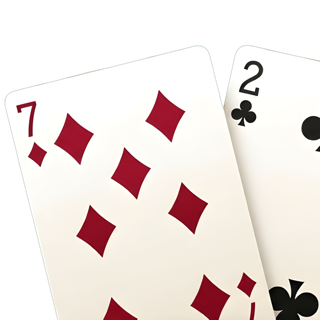

7-2 offsuit, the worst starting hand, has its own home-game side bet
Understanding what beats what is the first thing anyone needs to know before sitting at a poker table. This guide covers every hand ranking, real card examples, how tiebreakers work, and the mistakes beginners make reading their own hands wrong.
Print this page or share it with new players before your next game. Knowing the hand rankings shouldn't take mental energy at the table — it should be automatic.
The 10 Poker Hands Ranked (Best to Worst)
Watch with chapters and the full transcript →
Poker Hand Rankings Explained (and the Ties That Start Arguments)
1. Royal Flush — The Best Hand in Poker
Ace, King, Queen, Jack, and Ten — all the same suit.
- ▸Example: A♠ K♠ Q♠ J♠ 10♠
- ▸Cannot be beaten by any other hand
- ▸Odds: approximately 1 in 649,740 hands
- ▸If two players somehow made a Royal Flush (different suits), the pot splits — suits do not rank in poker
2. Straight Flush
Five consecutive cards all in the same suit. The Royal Flush is technically the highest Straight Flush.
- ▸Example: 9♥ 8♥ 7♥ 6♥ 5♥
- ▸Higher top card wins between two Straight Flushes (9-high beats 8-high)
- ▸Odds: approximately 1 in 72,193
- ▸Ace can be used as high (A-K-Q-J-10) or low (A-2-3-4-5, called a "wheel")
3. Four of a Kind (Quads)
Four cards of the same rank, plus any fifth card (the kicker).
- ▸Example: K♠ K♥ K♦ K♣ 3♠
- ▸Higher quads win (quad Kings beats quad Tens)
- ▸If two players have the same quads (from community cards), the highest kicker wins
- ▸Odds: approximately 1 in 4,165
4. Full House
Three cards of the same rank plus two cards of another rank (three-of-a-kind + pair).
- ▸Example: J♠ J♥ J♦ 9♣ 9♠ — "Jacks full of Nines"
- ▸The three-of-a-kind part determines rank first (Jacks full > Tens full)
- ▸Tie on three-of-a-kind: the pair part determines winner
- ▸Odds: approximately 1 in 694
5. Flush
Five cards of the same suit, not in sequence.
- ▸Example: A♣ J♣ 8♣ 5♣ 2♣
- ▸Between two flushes, compare the highest card (Ace-high flush beats King-high)
- ▸If tied on first card, compare second, third, and so on
- ▸Suits don't rank against each other — two flushes of different suits compare card values only
- ▸Odds: approximately 1 in 509
6. Straight
Five consecutive cards, any suits.
- ▸Example: 10♠ 9♦ 8♣ 7♥ 6♠
- ▸Higher top card wins (Ten-high straight beats Nine-high)
- ▸The Ace can play high (10-J-Q-K-A, called "Broadway") or low (A-2-3-4-5, called "the wheel")
- ▸Ace cannot wrap around — Q-K-A-2-3 is NOT a straight
- ▸Odds: approximately 1 in 255
7. Three of a Kind (Trips or a Set)
Three cards of the same rank, plus two unrelated cards.
- ▸Example: 7♠ 7♥ 7♦ K♣ 2♠
- ▸Trips = made with 1 hole card + 2 community cards. Set = made with 2 hole cards + 1 community card. Same hand strength, different terminology.
- ▸Tiebreaker: higher rank of the three cards (trip Aces beat trip Kings)
- ▸Then compare kickers if needed
- ▸Odds: approximately 1 in 47
Stop doing the math manually.
HG Poker logs buy-ins and rebuys and suggests who pays whom after the chip count. Players pay each other outside the app. Try it on iPhone or Android.
8. Two Pair
Two different pairs, plus one unrelated card (the kicker).
- ▸Example: A♠ A♥ 6♦ 6♣ K♠
- ▸Compare the higher pair first (Aces > Kings)
- ▸If tied: compare the lower pair
- ▸If still tied: compare the kicker
- ▸Odds: approximately 1 in 21
9. One Pair
Two cards of the same rank, plus three unrelated cards.
- ▸Example: Q♠ Q♦ 9♣ 5♥ 2♠
- ▸Higher pair wins (pair of Queens beats pair of Jacks)
- ▸If tied on pair: compare kickers in order (1st, 2nd, 3rd)
- ▸Odds: approximately 1 in 2.4 — the most common hand with a pair
10. High Card
None of the above. Just five unrelated cards — no pair, no flush, no straight.
- ▸Example: A♠ J♦ 8♣ 5♥ 2♦ — "Ace-high"
- ▸Compare highest card, then next highest, and so on
- ▸If all 5 cards are identical in value, the pot splits
- ▸Most common outcome when players miss the board completely
Tiebreaker Rules: The Kicker
When two players have the same hand category (both have two pair, both have a pair), the kicker decides the winner. The kicker is the highest card(s) not used to make the hand.
Scroll table horizontally →
| Player | Hand | Kicker | Result |
|---|---|---|---|
| Player A | A♠ A♥ K♦ 7♣ 3♠ | K | WINS — K kicker |
| Player B | A♣ A♦ Q♠ 8♥ 2♣ | Q | Loses — Q kicker |
| Player A | K♠ K♥ Q♦ J♣ 9♠ | Q-J-9 | TIE — same kickers |
| Player B | K♣ K♦ Q♠ J♥ 9♣ | Q-J-9 | TIE — pot splits |
Player A
- Hand
- A♠ A♥ K♦ 7♣ 3♠
- Kicker
- K
- Result
- WINS — K kicker
Player B
- Hand
- A♣ A♦ Q♠ 8♥ 2♣
- Kicker
- Q
- Result
- Loses — Q kicker
Player A
- Hand
- K♠ K♥ Q♦ J♣ 9♠
- Kicker
- Q-J-9
- Result
- TIE — same kickers
Player B
- Hand
- K♣ K♦ Q♠ J♥ 9♣
- Kicker
- Q-J-9
- Result
- TIE — pot splits
When the Board Plays: Using 0 Hole Cards
In Texas Hold'em, if the 5 community cards make the best possible hand (e.g., 10♠ J♥ Q♦ K♣ A♠ is on the board — a Royal Flush), every player still in the hand uses the board and the pot splits among all remaining players. This is called "the board plays" and confuses many beginners.
Who gets the odd chip when tied hands split a pot?
The Most Common Mistakes Reading Hands
- ▸Forgetting the best 5 cards out of 7 — in Hold'em you make your hand from 2 hole cards + 5 community cards. You use the best 5. Beginners often think they have to use both hole cards.
- ▸Missing a flush — if 4 of the community cards are the same suit, check if your hole card completes it
- ▸Missing a straight — community cards 6-7-8-9 mean any 5 or 10 in your hand makes a straight
- ▸Confusing trips and a set — same hand strength, but set (pocket pair + one community) is much better disguised
- ▸Not realizing your hand is on the board — if the community cards make a straight and you have a lower pair, your pair doesn't play; the straight on the board does
- ▸Thinking a higher pair always wins — a pair plus four of a kind on the board means everyone plays the four of a kind; the pair is irrelevant
Quick Cheat Sheet: Hand Rankings
Scroll table horizontally →
| # | Hand | Beats |
|---|---|---|
| 1 | Royal Flush | Everything |
| 2 | Straight Flush | 1-8 |
| 3 | Four of a Kind | 4-10 |
| 4 | Full House | 5-10 |
| 5 | Flush | 6-10 |
| 6 | Straight | 7-10 |
| 7 | Three of a Kind | 8-10 |
| 8 | Two Pair | 9-10 |
| 9 | One Pair | 10 |
| 10 | High Card | Nothing |
Print a laminated version of this table and keep it at your table. New players will thank you every game, and experienced players will stop second-guessing each other mid-hand.
Once you know the hands, the next step is tracking the game. HG Poker's iPhone and Android app manages buy-ins, rebuys, and automatic payout calculation so you can focus on the cards.
Key Takeaway
Run your home game without the math headaches. HG Poker tracks buy-ins, chip counts, and calculates who owes who automatically. Free on the App Store. → hgpoker.io/host-start
Related Reading
- ▸Texas Hold'em Rules: The Complete Beginner Guide for Home Games — /blog/texas-holdem-rules-complete-guide-home-games
- ▸Poker Positions Explained: Where You Sit Changes Everything — /blog/poker-positions-explained
- ▸Poker Glossary: Every Term You'll Hear at a Home Game — /blog/poker-glossary-home-game-terms
- ▸How to Host a Home Poker Game: The Complete 2026 Guide — /how-to-host-a-poker-night
Ready to run a cleaner poker night?
HG Poker is free to download. Setup takes 2 minutes.